Hiking in Banff
My trip to Banff started with a mad dash. My train in Calgary arrived at a remote suburban pickup point only five minutes before my bus to Banff was scheduled to depart.
I should mention a quick quirk about Calgary's CTrain that I forgot to note earlier: the fare system is a bit of a mystery. Traveling within downtown is completely free, but leaving or entering the downtown core requires a ticket. However, there are no barriers, and you can freely board or exit without scanning anything or showing a ticket to anyone. I asked a guy on the train how to buy one and ended up purchasing a ticket through the CalgaryTransit app, but no one ever checked it.
Naturally, I got lost at the station. A kind young lady pointed me in the right direction and asked about my itinerary. When I mentioned Winnipeg, she laughed and told me I would certainly regret that decision. Well, we will see in a few days.
The absolute worst moment of my trip happened the second I arrived at the hostel in Banff. My Chinese credit card simply did not work on their POS machine. My ICBC debit card worked, but it had less than $200 in it—not nearly enough to cover my stay. Because of roaming issues, I couldn't transfer money from my Chinese bank card to Canada. The staff were incredibly kind and caring, telling me I could stay while I figured it out, with one worker even promising a "worst-case scenario free stay." But the financial limbo stressed me out immensely for the entire evening and the next morning until I finally managed to receive a verification code and clear the fees.
With that panic behind me, I set out to explore. Banff is a paradise for hikers, drawing people from all over the world to its peaks. On my first hike up Sulphur Mountain, I met a couple from Denmark at the entrance, and we climbed to the top together. At the summit, they chose a more adventurous route to the mountain range's true peak, while I decided to stay on the safe side and walked the boardwalk to Sansen’s peak, the historic site for cosmic ray exploration and weather analysis. I didn't feel safe going downhill alone because of the frequent bear warnings, so I took the gondola down. That night, after dinner with a new roommate from Germany, we headed down to the hostel's basement bar. The music and noise were so deafeningly loud that we could barely hear each other speak.
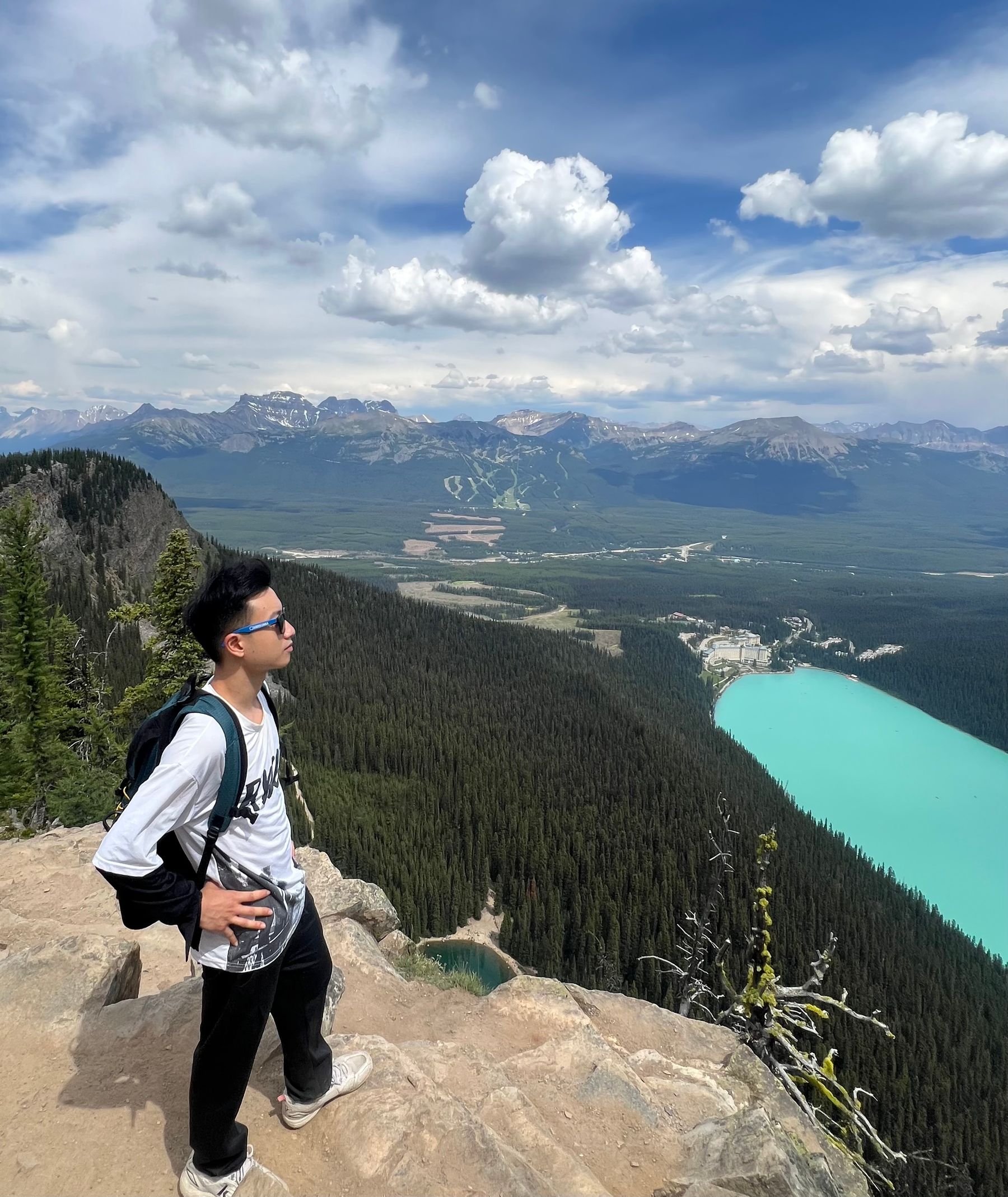
The next day was a solo hike to Lake Louise. Usually, the shuttle buses sell out weeks in advance—the website was completely booked when I first checked. But the next day, I got lucky and snagged a ticket returned by another traveler. The turquoise color of the lake is unbelievable, looking totally different from the view near the peaks.
I hiked past Mirror Lake and Lake Agnes under intermittent rain, which made the dirt quite slippery. The trail to Lake Agnes was easy, but it became much more difficult as I pushed toward the Big Beehive and the Plain of Six Glaciers. Suddenly, I was walking along the edges of cliffs, trekking over snow, and crossing streams. While the start of the trail was crowded, I was almost entirely alone on the 7-to-8-kilometer stretch to the Plain of Six Glaciers. It was beautiful—filled with snowy mountains, forests, grasslands, wildflowers, and massive rocks—but it got terrifying at one point. The trail crossed a flowing stream and was heavily blocked by snow. Standing there, completely alone in the mountains, was a real test of nerves.
By the third day, I was running on fumes. I joined my German roommate for a hike through Johnston Canyon. The walk to the Upper Falls was easy, but continuing to the Ink Pots, with their small, scattered lakes, was a climb. It was my third day of hiking in a row, right after a grueling 23-kilometer day, and my legs were completely exhausted on the way down.