Mosques, Markets, and the KL Tower at Night
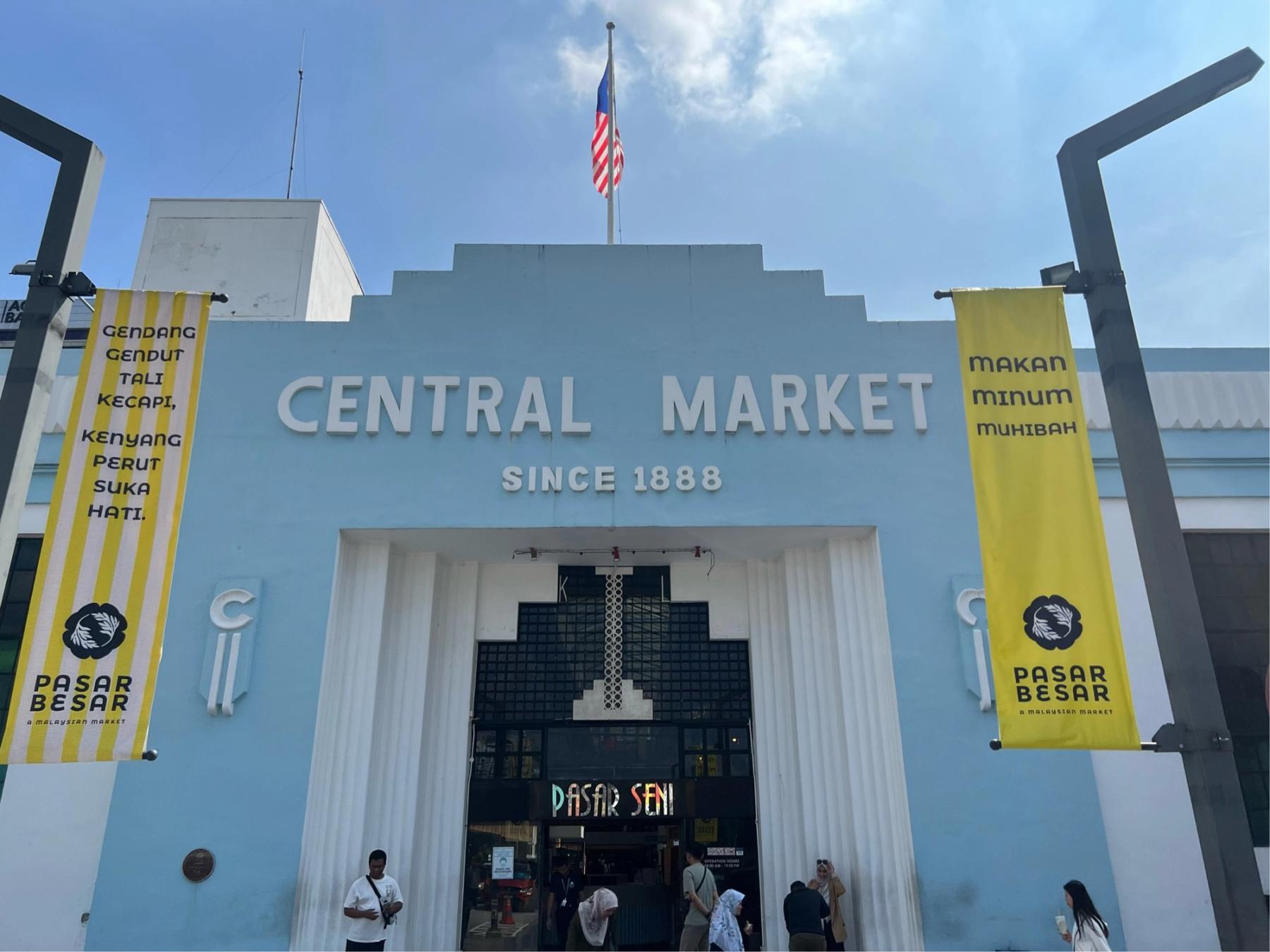
Day 4 had been the busiest day so far since I visited a lot of attractions today, starting from Pasar Seni (Central Market).
Pasar Seni is also known as art market since it is the center of Malaysian culture, art and craft.Built in 1888, it holds significant historical value and is a popular shopping destination for both international and domestic travellers. There are a warren of kiosks selling clothing, collectibles, souvenirs and local handicrafts both outside and inside a building with blue facade. The walkway outside the main building of Central Market is called Kasturi Walk. During my time of visit, it was sunny with extremely fierce sun but an arch roof and some fans provide a perfect shadow for cooling down a little bit when shopping at the outside stalls. The stalls on the outside are organized in a row styled as wooden huts in each side of the pathway, adding a touch of nostalgia to the overall experience. Indoors there’s AC so it’s more comfortable to shop especially during hot weather. There are 2 stories inside the building of Central Market with a large food court and Pasar Besar supermarket located at the ground level. At the ground level there arevarieties of artifacts such as bronze bowls (anti-disease, said the stallholder), acrylic gadgets, woven cup mats, wooden cups, pattern canvas bags and batik fans, to name a few. The lights aredim inside the building creating a quaintshopping vibe. The stalls at the second level, on the other hand, mainly focus on different types of dresses, especially batik pattern clothing. At the back of the main building of Central Market is the Annexe Gallery, which is the place for the exhibition of contemporary art, such as canvas paintings, batik drawing. One thing that need to be mentioned is that the entry of toilets in Central Market are charged. This was the first time that I encountered paid toilets in Malaysia (In Suria KLCC, there is a paid premium toilet but the regular ones are free of charge), which I encountered again later when visiting independence square and in a lot of places in Langkawi.
The fee required is usually not high, ranging from RM 0.5 to RM 1 depending on the locations, but still pissed me off so much that I rather wait until I found a free one.
I pretty much only window-shopped inside the main building and learned about different kinds of artifacts at the same time. One memorable moment waswhen I had a friendly conversation with a Pakistan batik stall holder, who expressed his love for China and cherished the close relationship between Pakistan and China. At one souvenir stall, a lady introduced to me the iconic landmarks in KL, which were reproduced by acrylic attached to a magnet..
Pasar Besar, the only supermarket within Central Market, is not as large as Cold Storage in Suria KLCC but still offers a wide range of products, from tropical fruits, local snacks to ice cream. The prices of goods here are more reasonable than in Cold Storage and I purchased a piece of hazelnut chocolate bar from Beryl’s, a local chocolate brand, and a cylinder of durian cookies. In the food court at the exit of Pasar Besar, I finally ordered the national dish of Malaysia, Nasi Lemak paired with Rendang Ayam (Spiced Coconut Milk Dry Curry Chicken), though it’s too spicy for me. The people who worked at the stall were very friendly to me, explaining the ingredients used in each dish in English to help me get an idea of what to expect because the names of them were in Malay.
Not far away from the Central Market is independence square, situated in front of the majestic Sultan Abdul Samad Building. This historical landmark square also has a 96m-high flagpole. It was here that the Malaysian flag was hoisted for the first time and Malaysia gained its independence in 1957. The unpredictability of weather in Malaysia was proven again here. When I arrived at the independence square, the sun was fiercely shedding light at me burning every piece of my skin. When I was about to leave the independence square and headed to Jamek Mosque nearby, a heavy rainfall came in and I had to hide underneath a covered place.
Even when it was raining heavily, I decided to pay a visit to Jamek Mosque but unfortunately, it had been closed when I arrived at its entrance. I then took a detour and walked along Klang River to the opposite bank of Jamek Mosque, which offered a front view of the mosque. Continuing walking along Klang River, I reached The River of Life, a convergence point of two rivers: Klang River and Gombak River. It is said that the convergence point was once muddy, murky and filthy. The Malaysian Government then initiated the River of Life project to transform the polluted Klang River into a thriving and lively waterfront dotted with quant cafes, scenic bicycle lanes and murals on the façade of buildings. During my time of visit the water was not very clean with a few garbage flowing along the river. There was mist created on each bank, adding a bit mysterious feeling to the flowing water. According to the official website, there are several night light shows at the River of Life that turn the water a striking blue, so perhaps nighttime is better for visiting this site.
Another famous mosque situated nearby is National Mosque of Malaysia. It is the largest mosque in the country with a capacity of 15,000 people. Surrounded by a beautiful garden with trees and grasslands, it features a 73-metre-high minaret and a 16-pointed star concrete main roof. The umbrella, synonymous with the tropics, is featured conspicuously – the main roof is reminiscent of an open umbrella, the minaret's cap a folded one. Reflecting pools and fountains are spread throughout the compound.To enter the mosque, visitors are required to take off their shoes but bags are allowed to carry in. Robes are kindly lent to visitors who are inappropriately dressed. Due to the rainy weather, my feet had been soaked into rain water for a while so it was such a relief to be able to walk barefoot on the covered pathway. Once climbing onto a series of stairs, clear instructions are provided for guided route, so it’s not easy to get lost inside though the premise is large. To the left lies a small museum which displays 2 miniatures showing the development of the magnificent building and its surrounding greenery. A significant difference of the site compared with what was initially built was a larger area of grassland and more trees are planted around the mosque. Following the route, I reached the open umbrella chamber which is the main prayer hall and was told that an afternoon pray was about to start in 5 minutes, so I sat down in an area near the gate designated to visitors to watch prayer. The main hall was air conditioned and there’s blanket on the floor, so it’s actually quite enjoyable staying inside escaping the heat of hot summer.
Islam has five pillars and prayer is the second of them. It is the way that Muslims seek closeness and connect with Allah, Creator of the world. Although Muslims can pray at anytime, they are obligated to perform five prayers daily at specified times: dawn (before sunrise), mid-day, late afternoon (which I witnessed), just after sunset and nightfall. Devout Muslims also perform voluntary prayers before and after the obligatory prayers. Obeying Allah’s command in The Qur’an, Muslims pray facing the direction of Ka’bah at Mecca in Saudi Arabia, which is the destination of their once-in-a-lifetime pilgrimage. Before prayer, Muslims should also cleanse their body in the form of Ablution.
Before the pray started, Muslims inside the hall were scattered around. Some were doing their worshipping on their own while others were chatting quietly in a group. When it’s time for prayer, the call (azan) was announced and all the Muslim men gathered at the front of the hall, standing shoulder by shoulder in rows, while Muslim Women, wrapping hijab around their heads and necks, gathered at the back of the hall, also standing side by side. The prayer comprised of several postures, including standing, bowing, prostration and sitting. These series of body postures were repeated for several cycles to complete the prayer which lasted about 10 minutes. When it ended, most Muslims left the main hall while some still sticked around doing their own prayer.
A little trivia about the mosque is that there were bottles of mineral water for sale but it was totally unsupervised and 1 bottle only cost RM 1, seeming to be manifesting the third pillar of Islam: charity. There’s also a small museum under the ground level for more details about pilgrimage, which is informative as well.
After visiting the mosque I decided to take a bus to KL Forest Eco Park. Taking a bus in KL for the first time, I found the bus stop extremely difficult to locate. I had to ask locals several times to finally find the stop suggested by Google Maps, which turned out to be in a different location than indicated in the app.Unfamiliar with the appearance of the bus I needed, I missed the first one that arrived. After a long wait caused by a lengthy red light before the bus turned right to reach the stop, the bus finally arrived. Following other passengers who were also going to take the bus, I queued up. A guy in front of me told me that a public transport card was required to pay for the bus ride, which I didn’t have because I had been paying for all my train rides with cash. He kindly offered to pay for me, but just as we were chatting, the door of the bus closed and it drove away, ignoring the fierce knocking of the passengers. It was shocking to me that such a thing could happen; I was left standing there, surprised and frustrated by the unexpected situation. Another long waiting time passed by, the third bus arrived and I finally boarded the bus. That guy paid the fee for me, but after searching for the payment methods available for bus ride in KL, I realized that credit card issued by Mastercard/Visa is accepted as well and this was made possible by a Germen passenger travelling to KL before but frustrated by the inconvenient payment method for tourists. The traffic condition around dinner time in KL was abysmal, so it took me a long time to finally arrive. It’s also worth mentioning that another kind fellow on the bus reminding me to get off at the right stop after knowing where I was going. After going to the toilet in Wisma New Asia, I got lost once again, but was helped by a woman who worked there to find my way out.
After all of these incidents, the sky was nearly dark and I was both hungry and exhausted, looking for something to eat while finding the way to the park. I was planning to have dinner in a Michelin Thai restaurant but accidentally stepped into a German restaurant nearby. Nevertheless, I settled down and ordered a platter of mix sausage inclusive of salad bar and a bread basket, and tonic water, which is a kind of bubbling water. It was a hearty and traditional German meal featuring a variety of sausages served with roasted potatoes. The sausages appear to be different types, possibly including bratwurst and other regional varieties. The roasted potatoes are mixed with onions, baconand sauerkraut, providing a rich and savory side.The crispy fried onions, at the top of sausages, are traditionally used as a garment in German cuisine to add a crunchy texture and a savory flavor to dishes, especially those featuring meats and sausages. Sauerkraut is a traditional German side dish made from finely cut, fermented cabbage. It has a tangy, slightly sour flavor and is commonly served with sausages. The salad bar featured unlimited supply of vegetable and meat, including
- white cabbage,
- slices of sausage,
- carrot and tomato,
- fresh lettuce leaves,
- mashed potato,
- shredded red cabbage.
Accompanying the meal was a basket of bread, which included a pretzel and slices of Nordlander and Sourdough bread, typical of German cuisine. There were also two containers providing Schmaltz and white pepper for seasoning. The people working in the restaurant were very approachable too. One of them were even willing to explain to me what the names of dishes on the menu suggest.The restaurant was quite empty when I was eating there, so I was able to talk with them a lot. I asked them whether their business would be better at the weekends and whether the Muslim aspect of Malaysia affects their business since German restaurants usually feature pork. They complained to me how little ordinary people know about German cuisine and how we are more attracted to Italian or Thai restaurants nearby due to TV dramas.
A very funny encounter.
It was 8.30 pm when I finished the quite enjoyable meal and I was told that the park had closed, so I went along a spiral sidewalk to take some photos of KL tower at night. By the way, Petronus Twin Towers, KL tower and Merdeka 118 are my favorite buildings in KL, but only the twin towers and KL tower are embedded with lights at night, making them even more beautiful while Merdeka 118 is kind of dull at night.
Then I went back to Bukit Bintang, the district where I lived, to take a walk inside the luxurious Pavilion KL, which houses many luxury brands around the globe and is shiny and glittering. At the main gate of the shopping paradise lies a fountain where 3 huge bowls decorated with the bloom of Hibiscus, national flower of Malaysia, are stacked together, symbolizing Malaysia’s multiracial culture living harmoniously in unity and the growing aspirations of the people. Just before the main entrance, a group of young girls wearing very hot costumes were dancing to the R&B music, I guess, which was really refreshing to see because the outfits of Malaysian women are usually quite conservative due to its religious belief. Most of the audience, however, were international people and Malaysian men. It seemed that this is not the cup of tea for Malaysian girls, which is also understandable. The shopping experience inside Pavilion KL, well, was just what you would normally expect for a high-end shopping mall, except that there was an exhibition by tea shop CHAGEE with some mini-games to play which I was not interested in. Just before its close hour, I hurried to Berjaya Times Square (Berjaya is a billionaire in Malaysia, a Langkawi Grab driver told me) which is smaller and more down-to-earth than Pavilion KL with a wide range of shops. After an exhausting day, I treated myself with a cup of guava juice in AZ Juice Bar, and a new adventure in Langkawi is waiting for me tomorrow!